

Welcome

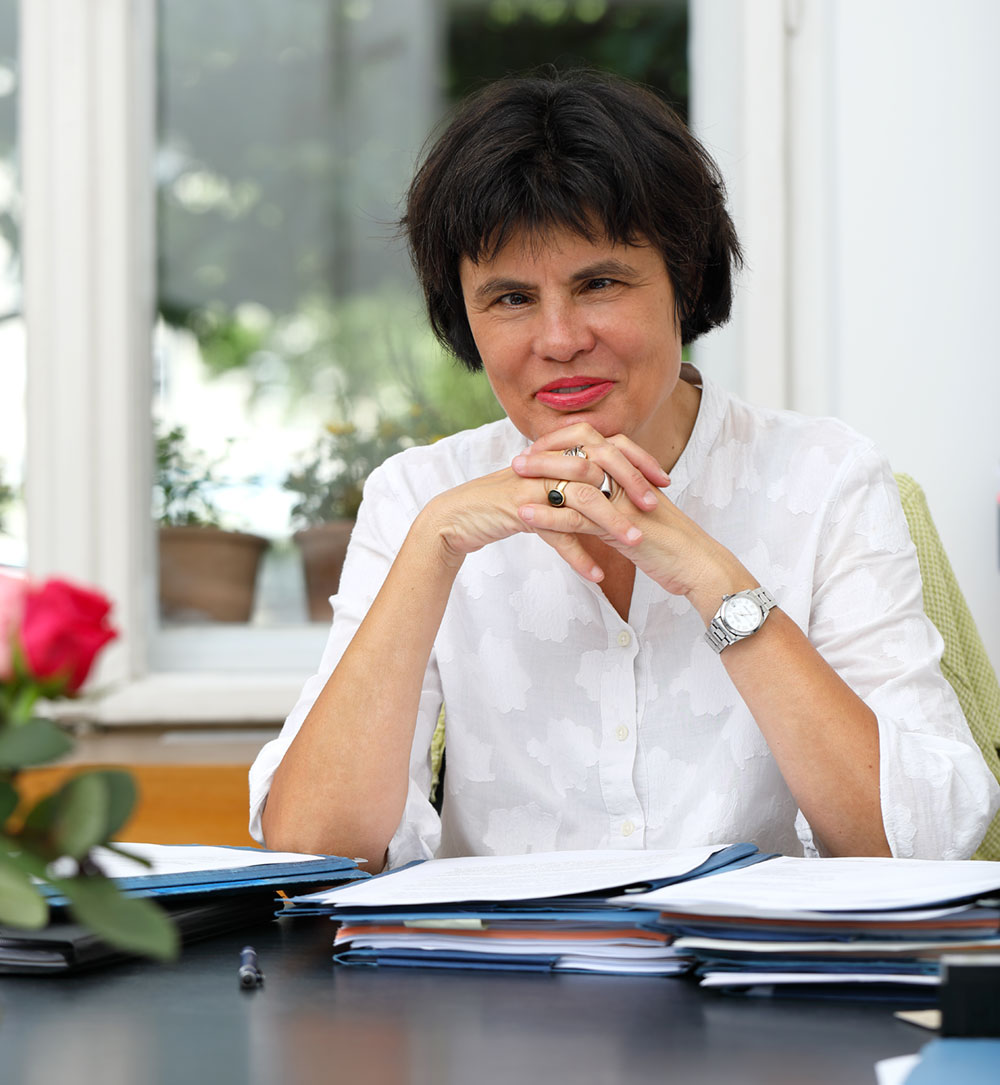
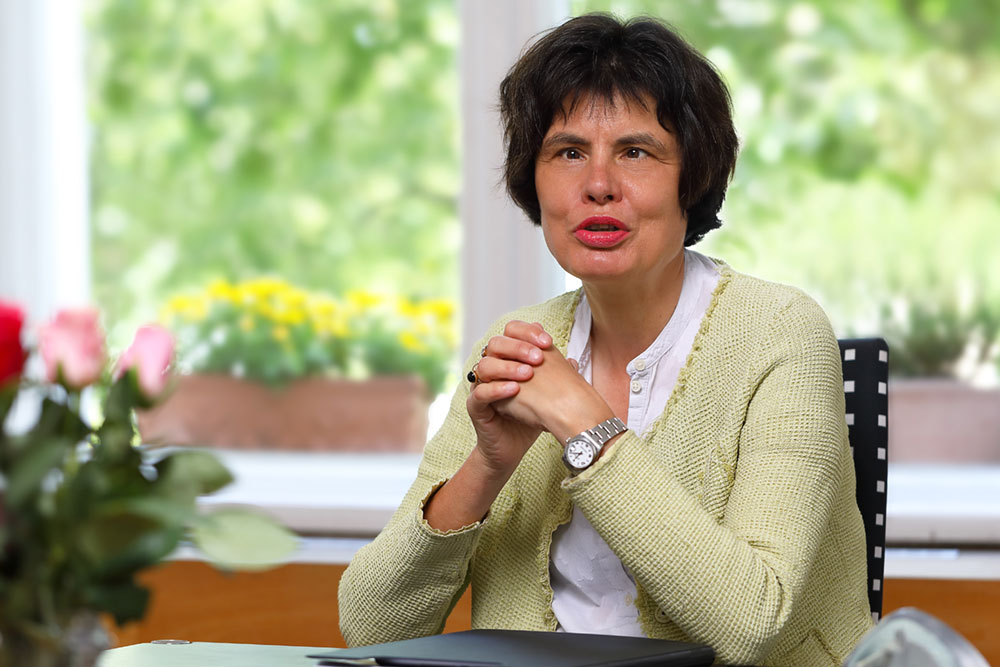
Welcome to the law firm of Svenja Schmidt-Bandelow, which has been

founded in Berlin in 1996. As a specialist lawyer for family law as well as a specialist lawyer for migration law and mediator and with the associated many years of experience in family law, international family law as well as in the area of international private law, European law and migration law, you receive competent advice and representation. My aim is first of all to find an out-of-court solution. However, if this does not lead to an agreement or settlement, I can represent you before the competent court – also outside Berlin. In divorce and adoption cases involving Germans living abroad, I will be happy to represent you before the Schöneberg Local Court in Berlin, which has exclusive jurisdiction.

Consultations, mediations and correspondence in English, French, Italian and Swedish are a matter of course for me. Europe-wide cooperation with colleagues supports my work in cross-border family law matters.

You are welcome to contact me with the following concerns, for example:

German and international family law

  • Divorce in general and in particular in an international context (e.g. binational marriages and couples, divorce for Germans living abroad)
  • Marriage contract, choice of applicable law, matrimonial property law, maintenance law, especially in an international context
  • Custody and access rights
  • International child abduction with reference to the Hague Convention on the Civil Aspects of International Child Abduction
  • Recognition of a foreign adoption

Migration law

  • Residence permits (especially family reunification, work permits, settlement permits)
  • Residence card for family members of EU citizens
  • Naturalisation
  • Citizenship card
  • Re-naturalisation of German Jews and their descendants as well as Jews living in Germany during the Nazi era

Do not hesitate to contact me with other family and migration law matters.

Office hours:

Mon – Fri: 10 am – 6 pm and by appointment

Appointments

Please call us to book an appointment: Monday – Friday, 10 am –7pm +49 30 229 082 080

Consultations face-to-face, by phone, FaceTime or Jitsi Meet

Reach the secretariat via Jitsi Meet if you do not want to call by phone from abroad. We will send you a link for this on request.

to contactform   |   ra@svenja-bandelow.de (please indicate your phone number)

Lawyer

CURRICULUM VITAE

Career

  • Law studies at the Free University of Berlin with a focus on international private law and comparative law
  • Legal traineeship “Referendariat” in Berlin and training at the legal service of the European Parliament in Luxembourg
  • 1996 2nd state law examination and admission to the bar at the Regional Court of Berlin
  • Independent lawyer since 1996
  • 2004 Admitted as a specialist lawyer for family law
  • 2014 Completion of in-service training as mediator
  • 2019 Admitted as a specialist lawyer for migration law

Memberships

In order to keep abreast of international legal developments, I maintain memberships in the following European associations and working groups:

  • German-French Lawyers‘ Association (DFJ)
  • German-Italian Lawyers‘ Association (DIV)
  • German-Nordic Lawyers Association (DNJY)
  • Association of Binational Families and Partnerships (iaf)
  • Working Groups on Family and Immigration Law of the German Lawyers’ Association
  • MIKK e.V. (Mediation in International Conflicts Involving Parents and Children)
  • Amnesty International

Lecturer, consultant & author

I am in continuous education and training and I also pass on my expertise as a consultant, lecturer and author:

    • Since 2007 Consultant and lecturer for the Association of Binational Families and Partnerships (iaf).
    • 2012 – 2014 Lecturer in specialist lawyer courses for ARBER Seminare GmbH for international family law.
    • Co-author of the guidebook on immigration law and international family law „Binationaler Alltag in Deutschland“, published by the Association of Binational Families and Partnerships (Verlag Brandes & Apsel, 2012)
    • Co-author of the book „Paarbeziehungen, Bikulturalität, Globalisierung“, published by the Association of Binational Families and Partnerships (Lit-Verlag).

Regular further training in family and migration law as well as in mediation, including at international conferences, is very important to me in order to provide my clients with up- to-date specialist knowledge.

Knowledge of languages

I have a very good knowledge of the languages English, French and Italian, as well as a good knowledge of Swedish. Consequently, I am able to hold conversations without any problems in English, French and Italian. I am able to communicate in Swedish.

Law Office

OFFICE COMUNITY & MY COWORKER

I am in an office partnership with the following colleagues: Viktoria Lokau, lawyer and notary, Ulrike Klein, lawyer, Elmar Hörnig, lawyer, and Susan Zaharii, lawyer.

Elena Kindel

HOW TO GET HERE

Our office is located at Hardenbergstraße 19 in City West in the Charlottenburg district, directly next to the Chamber of Industry and Commerce (Hardenbergstraße / corner of Fasanenstraße) and the C/O Berlin Foundation. Our office is easily accessible by underground and S- Bahn. Get off at Zoologischer Garten station. From there it is only a few minutes‘ walk: Leave the station on Hardenbergstraße in the direction of Ernst-Reuter-Platz. (the Gedächtniskirche is in the opposite direction).

Coming from the station, you will find the office on the left-hand side directly next to C/O Berlin Foundation. You can reach Zoologischer Garten station by the means of transport listed below:

Bus

M46, 100, 109, 110, 145, 149, 200, 204, 245, 249, X9, X10, X34

S-Bahn
urban railway

S5, S7, S9, S75

U-Bahn
subway

U2, U9, U12

Regionalbahn
regional railways

RE1, RE2, RE3, RE4, RE5, IR14

Immigration Law

The Residence Act

The German immigration law is regularised by the Residence Act, in force since January 1, 2005.

Two types of residence permit

In Germany, there are two kinds of residence permit: a limited and an unlimited one.

In order to achieve the unlimited residence permit, sufficient language skills are required and knowledge of the legal and social system has to be substantiated. As a rule, attending the so-called integration courses can fulfil this requirement, unless the applicant disposes of an adequate school education. In principle, all new immigrants in Germany should participate in these integration courses.

Moreover, a basis for the pension plan has to be created. As regards the time schedule, you have to be in possession of a residence permit within five years, unless you cohabit with a German spouse or child within a domestic community. In this case, three years are sufficient.

Visa issues

Foreigners who do not live in the Federal Republic of Germany yet but wish to travel to Germany, have to apply for a visa at the German Embassy in their home country. A visa can be granted for the purpose of taking up employment or studies, for family reunion or for tourism purposes.

Persons desiring a visa for family reunion or marriage have to submit proof of the acquisition of German language skills at level A1 (basic knowledge). The German Embassy is not obliged to justify the denial of a visa. If a visa request is denied without giving reasons, objection can be made by means of the opposition procedure (Remonstratonssverfahren).

If another remonstration notification is sent out, it is possible to institute proceedings before the Administrative Court of Berlin within one month after the denial has been notified.

Residence and work permits

The residence permit is bound to a specific purpose of residence and is granted together with the work permit, if the employed activity is permitted by the legal regulations.

Autonomous residence permit

Foreign spouses can get a residence permit of their own, independently from their German spouse, at the end of a three-year period.

In this regard, a legal consultation is advisable, as people seeking counselling tend to be unsure about this point.

EU-citizens and their family members and spouses

EU-citizens have a right to move freely for work purposes, i.e., they do not need a work permit.

However, the EU-citizen has to finance his stay from his own resources and must have sufficient health insurance cover. You do not need a freedom of movement certificate in order to prove your right of free movement. Such a certificate is not issued by the Immigration Office.

However, it is different if you are an EU citizen and live together with a family member or spouse from a third country. In this case, your family member or spouse is also entitled to reside in Germany and enjoys the same rights as you do. In this case, however, a so-called residence card must be applied for at the Immigration Office.

Naturalisation

The naturalisation is another important issue in immigration law. What are the requirements, under which a foreigner can be naturalised in Germany? After a period of eight years of permanent residence in the Federal Republic of Germany, there is a right to be naturalised, in exceptional cases already after seven years. In the case of marital cohabitation with a German citizen, naturalisation can be applied for already after three years.

In principle, when applying for the German citizenship, the original citizenship has to be given up. According to the law, dual nationality or a naturalisation with multiple nation-alities are accepted only in exceptional cases.

The obligation to give up their original citizenship does not apply to citizens of EU member states and those of Switzerland. Also, a dual nationality is always irrelevant when the citizenship is acquired through birth. For example, a child can easily acquire the German nationality through the mother and the Canadian one through the father.

Issuance of a certificate of citizenship

This can become necessary if you are in possession of the German nationality since birth but have never been in possession of a German passport. Before a German identity card is issued, the presentation of a certificate of citizenship is often required.

The purpose of such a certificate is to demonstrate that you possess the German nationality. The competent authority is the Federal Administration Office (Bundesverwaltungsamt) in Cologne. www.bva.bund.de

Further information

Information on these topics can be found on the info-page:

The Schengen Agreement
Freedom of Movement in the EU
The EU Blue Card
Self-Employed non-EU citizen
Marriage in Denmark

TO INFO-PAGE IMMIGRATION LAW

***

Further information

Selection of lectures on immigration law

PDF-File about the topic:
Familiennachzug im nationalen und europäischen Kontext unter Berücksichtigung der im Jahre 2015 und 2016 erfolgten Gesetzesänderungen im Aufenthaltsgesetz (17.06.2016)
*
PDF-File about the topic:
Besonderheiten des Eheschließungsverfahrens im In- und Ausland für binationale Paare (18.03.2011)

Important links concerning immigration law:

www.berlin.de/labo/
Here the address and itinerary to the aliens registration authority of Berlin can be found. Moreover, information on opening hours and the possibility to arrange an appointment online is provided.

www.berlin.de/sen/ias/index.html
On the homepage of the State Commissioner for Integration and Migration of the Berlin Senate, constantly updated information is provided.

www.bundesregierung.de/Webs/Breg/DE/Bundesregierung/BeauftragtefuerIntegration/beauftragte-fuer-integration.html
The Federal State Commissioner for Integration and Migration provides information on her office and work. An encyclopaedia where terms referring to immigration law like deportation and rejection are explained can also be found there.

www.bmi.bund.de
On the website of the Federal Ministry of the Interior, comprehensive information on many issues concerning immigration law can be found in the section “Themen A-Z” under the keyword “Ausländer, Flüchtlinge und Asyl“ (foreigners, refugees and asylum matters).

www.auswaertiges-amt.de
Numerous forms, lists of embassies and country information can be downloaded. Information on the requirements for the legalisation of civil status certificates is provided.

www.bamf.de
On the homepage of the Federal Agency for Migration and Refugees (Bundesamt für Migration und Flüchtlinge – formerly Bundesamt für die Anerkennung ausländischer Flüchtlinge) you can find background information on the topics of integration, migration, language acquisition and the right of asylum.

www.asyl.net
Provides information relating to the situation on asylum law in approximately 100 countries as well as a large collection of links and judicial decisions.

www.amnesty.de
Among others provides access to the annual reports of Amnesty International including background information on countries.

Family law

Family law in the legal practice includes, among others, the following areas:

  • Marriage at home and abroad
  • Marriage contract
  • Divorce
  • Matrimonial property law, also with reference to foreign countries
  • Parentage law
  • Contact and custody law
  • Adoption law

Marriage and prenuptial agreement

Even before marriage, the partners can conclude a prenuptial agreement if, in deviation from the regulation of the statutory matrimonial property regime of community of gains, another matrimonial property regime, namely the separation of property, is to be agreed.

Without a prenuptial agreement, there is the possibility of equalization of the assets acquired during the marriage (compensation of accrued gains), which can be claimed in the event of a divorce.

A prenuptial agreement can also include a waiver of postmarital maintenance and an exclusion of pension rights adjustment in the event of divorce. It may also contain a choice of law regarding the applicable law.

For information on marriage for bi-national couples, please click here.

Bi-national couples

Couples with different nationalities frequently require advice even before getting married with regard to the papers necessary for a marriage in the Federal Republic of Germany and in particular in connection with obtaining a marriage eligibility certificate for the foreign partner.



Divorce

The most important application of family law is divorce.

In divorce proceedings, at least the spouse must be represented by a lawyer who files the divorce petition. If the other spouse agrees to the divorce, he/she no longer needs to be represented by a lawyer.

In principle, a divorce under German law requires a separation of one year. In the course of the divorce, the future pension equalization of the spouses is clarified (rights adjustment).

For information on divorce for binational couples, click here.

Parental responsibility and rights of access in the event of divorce

In the event of divorce, it makes sense to reach an agreement on the future exercise of parental responsibility as well as on the arrangement of the right of access.

A transfer of sole custody to one parent can only be considered in exceptional cases.

Separation and divorce agreements

It may be necessary to conclude agreements on the consequences of separation and divorce in order to regulate compensation of accrued gains, child support, post-marital support or pension rights.

Alimony issues during the separation phase

During the separation phase of the spouses, there is a claim to separate maintenance for the lower-income spouse.

For joint children who are cared for by one parent, child support can be claimed, which is determined according to flat rates of the Düsseldorf Table.

Property division in the event of divorce

In connection with a divorce, it may be necessary for the parties involved to divide their assets, for which comprehensive legal advice and examination of the facts of the case are required.

For example, the following must be clarified

  • Division of the household goods
  • Use of the marital home
  • Future regulation and structuring of joint home ownership
  • Division of property

Divorce and property issues

In the event of a divorce it may prove necessary to decide what will happen to any property or assets the couple own.

For this one should seek detailed legal counselling and advice concerning the facts of the case.

Matters which may require consideration include the division of household belongings, the use of the family home and how to deal with jointly owned houses or apartments. It may also be necessary to reapportion assets acquired during the course of the marriage.

Maintenance and support

During the separation period the partner who is earning less has a right to maintenance.

This is set at 3/7 of the income difference. Child support can be claimed for any children the couple may have, the amount being determined by the rates given by the so-called Düsseldorf-Index – or in the former East Germany by the Berlin-Index.

The amount payable in maintenance and support depends both on the ability of the person obliged to pay and on the needs of the recipients.

Divorce and bi-national couples

If a bi-national marriage ends in divorce, problems often arise with regard to the law which must be applied.

My experience in the field of international private law can help clear up which law is relevant to the divorce and whether the divorce can take place in Germany. For instance, the jurisdiction of German family courts is given if one of the partners is normally resident in Germany.

The German courts also have international jurisdiction even in the absence of such a residence if one of the partners is German or a German living abroad.

My knowledge of the law affecting foreigners allows me to brief clients on the effects a divorce would have on the residence status of the foreign partner.

International Family Law

International family law has gained enormous importance with the increase in cross-border relationships and marriages. Important issues in this context are the applicable law, the international jurisdiction of the family court, and the particularities of marriage and divorce of binational couples.

Applicable law

In cross-border relationships, the question arises,  which law is applicable to the marriage, the divorce, the regulation of the property law, the alimony law and the custody as well as the right of access.

This question is governed by private international law, which can be found in EU regulations (e.g. the Rome III Regulation (EU) No. 1259/2010 of 20.12.2010, international agreements or subordinate national law.

The question of the applicable law plays a role in particular when concluding a marriage contract.

If it is clear to a couple that in the future they will not only live in Germany or even outside the European Union, it is advisable as a precaution to make a choice of law regarding the applicable law for the divorce and its consequences. During a consultation, I can clarify with you in advance what would make sense in your case.

Subsequently, I can draft the prenuptial agreement for you if you wish.

Link: Council Regulation (EU) No 1259/2010 of 20 December 2010 implementing enhanced cooperation in the area of the law applicable to divorce and legal separation (europa.eu)

International jurisdiction of the family court

In addition to the question of applicable law, the international jurisdiction of the family court is always an important aspect of international family law, i.e. „Can I get a divorce in Germany?“ or „Is a German court authorized to decide on parental care and contact?“.

For example, the Berlin-Schöneberg Local Court may have international jurisdiction over divorce proceedings for Germans living abroad and their partners. However, for Germans living abroad in the EU and their partners, Regulation (EC) 2019/1111 (Brussels II-b) must be observed with regard to a possible priority jurisdiction of a court of another EU member state.

Link: Council Regulation (EU) 2019/1111 of 25 June 2019 on jurisdiction, the recognition and enforcement of decisions in matrimonial matters and the matters of parental responsibility, and on international child abduction (europa.eu)

Marriage for binational couples

In the case of binational couples, there is often a need for advice prior to the marriage regarding the papers required for a marriage in the Federal Republic of Germany, especially in connection with the provision of a certificate of marriageability.

Furthermore, it is important to find out which law applies to the marriage and the divorce and whether a choice of law makes sense.

Divorce for binational couples

In the context of a divorce of binational marriages, problems often arise regarding the applicable law.

In the case of binational couples, it is advisable to consider making a choice of law with regard to the applicable law for the divorce and the property law. Here, my knowledge of international private law can clarify which law is applicable to the divorce and whether this divorce can be carried out in Germany.

The jurisdiction of German family courts is given, for example, if there is a habitual residence in Germany. The international jurisdiction of the German court can also exist if there is no habitual residence, if a German lives abroad but outside the European Union. In addition, my knowledge of aliens law offers the possibility of determining the further status under residence law of the foreign partner(s) after separation has taken place.

International Family Law

Find these themes on information page:

***

International Conventions:
• Recognition of decisions concerning custody of children within the European Union as well as protection from child abduction
• Hague Convention on the Civil Aspects of International Child Abduction

***

Marriage in Denmark
• Marriage in Denmark – Overview

***

TO INFORMATION PAGE

Mediation

Mediation

Mediation is a conflict resolution process and is an alternative to litigation. It is the attempt of the conflicting parties to find a solution to their dispute on their own responsibility with the support of the mediator. The mediator is impartial and neutral. He/she helps to create clarity so that the mediants (parties to the conflict) can work out a solution themselves that corresponds to their interests.

Mediation opens up the possibility of an alternative dispute resolution for you, with probably less time and costs than in the case of conducting a trial. In mediation, unlike a judge, the mediator can address your particular needs, wishes and interests.

I have completed an in-service training as a mediator according to the standards and training guidelines of the Bundesverband Mediation e.V. totalling 200 hours. Furthermore, I have additionally qualified in the field of cross-border family mediation by completing another 50 hours at MIKK e.V. (Mediation in International Child Conflicts, www.mikk-ev.de).

Main focus

The focus of my mediation work is in the area of family mediation. This covers in particular the areas of divorce and separation consequences. These are mostly conflicts in the division of property, in particular also the property dispute, questions regarding maintenance as well as access and custody rights.

Furthermore, I offer my mediation services in the field of international family mediation.
These are cases in which the conflict has a connection to a foreign country, either because of the nationality of one of the parties to the conflict or because the case itself has a connection to a foreign country, whereby mediation in cross-border proceedings is part of my work. Particularly when, in the course of separation, it is a question of the possible relocation of one parent with the joint child to the country of origin of this parent, there are often disputes between the parents about this.

If, for example, a German mother who has lived with her Italian husband in Italy wants to move to Germany with the child and the husband does not agree, this question can only be settled in court if the parents are unable to come to an agreement. Conversely, the case could also be that the Italian mother, who has lived with her German husband in Germany up to now, would now like to live with their son in Milan again after the separation and does not receive her husband’s consent to this.

Since court proceedings often have an uncertain outcome and are also stressful for the children, mediation is an obvious choice in such situations in order to address the fears of both parents and also the needs of the child.

My many years of professional experience as a specialist lawyer for family law and in international family law as well as my intercultural competence and numerous language skills are an advantage for my work as a mediator. I also conduct mediations in English, French and Italian. Swedish can also be used as a supplementary language.